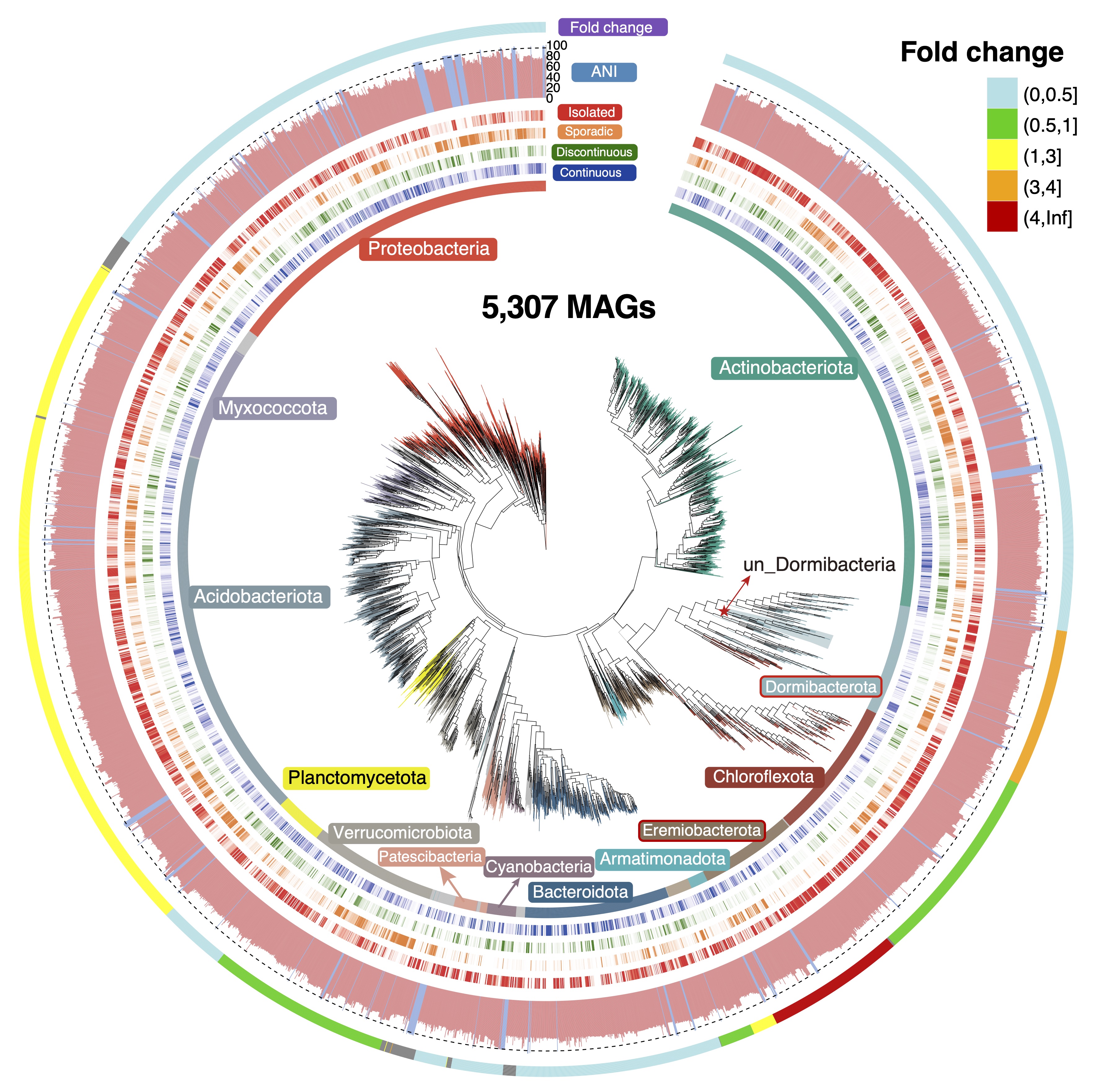
MAGs Overview
These 5,307 MAGs represented 17.6±8.6% of the microbial communities in Greenlandic soils by coverage, in stark contrast to the 0.001%–2.8% recovery rate of MAGs from eight other studies focused on the Arctic and the global environments.
Furthermore, a comparison of Greenlandic MAGs to those from 11 other studies and NCBI databases revealed that 94.8% of the MAGs had a maximum average nucleotide identity (ANI) below 95%, indicating we uncovered a large proportion of potentially novel species (n=5270/5307), genera (n=1710/5307), families (n=303/5307) and order (n=53/5307) from the Greenlandic microbiome.
Phylogenetic analysis of the MAGs revealed extensive microbial diversity in Greenlandic soils, identifying 5,277 bacterial and 30 archaeal MAGs. The most abundant phyla were Actinobacteriota (23.0%), Proteobacteria (21.8%), and Acidobacteriota (17.0%).
Our study provided a phylogenetic gain of 48.8%, significantly expanding the representation of known taxa, particularly Eremibacterota and Dormibacterota, which were respectively 6.9 and 3.4 times greater than those in the Genome Taxonomy Database (GTDB) (Release 95).
Sankey Diagram Visualization
MAGs Browser
Genome Information
| ID | Completeness (%) | Contamination (%) | Genome Size | GC_Content (%) | Quality | GTDB Classification | Contigs | tRNA | 5S rRNA | 16S rRNA | 23S rRNA | Total rRNA | NCBI Classification | Min Contig | Max Contig | Mean Contig | Median Contig | N50 |
|---|